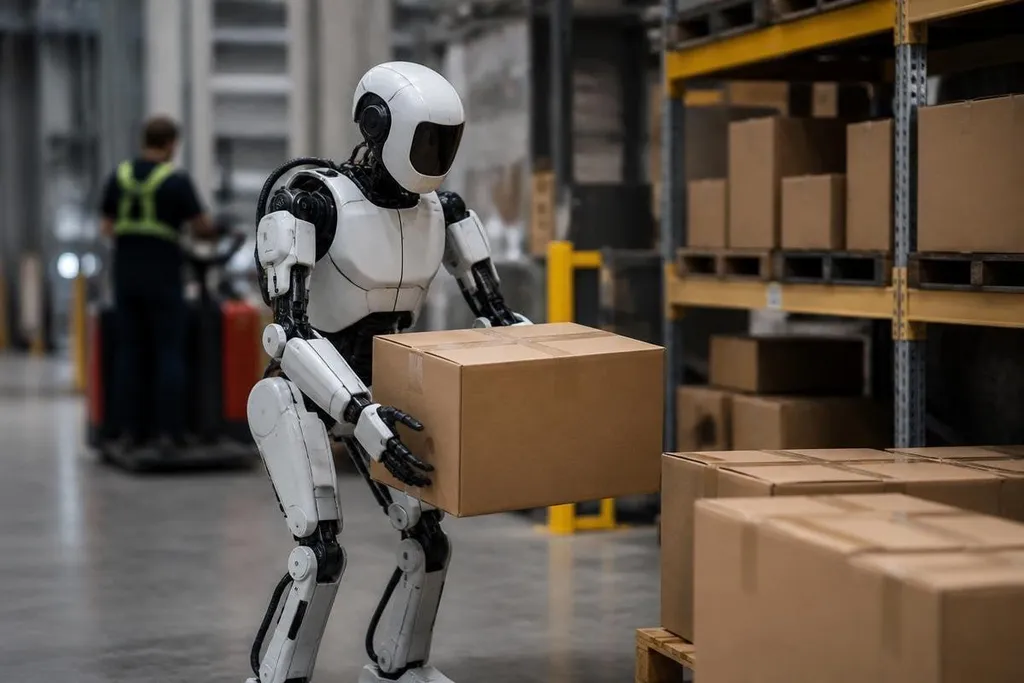
A humanoid robot has a human-shaped layout: two legs, two arms, a torso, and a head or sensor mount. That shape may help it work around spaces built for people, but shape alone says little about useful output.
For an operations manager, the real question is narrower: can a robot complete a paid task safely, often enough, and at a cost the site can carry? No evidence pack was supplied for this topic, so this article avoids claims about named companies, job losses, prices, or deployment results.
Quick read
- Human-shaped hardware may fit existing doors, shelves, tools, and workstations.
- Walking, hand control, battery life, and safety all limit useful work.
- A pilot needs measured task results, not a video of one successful action.
Why the human shape matters
A warehouse, factory, or care site already has floors, stairs, shelves, handles, and tools made for human bodies. A robot with two legs and two arms may use that layout without forcing the site to rebuild every work area.
That benefit comes with a hard engineering cost. A wheeled robot keeps a wide base on the floor. A biped must sense its balance, place each foot, and recover when the floor, load, or contact changes. A fall can damage the robot, the goods, or a nearby person.
Hands create another test. A gripper that closes around one box may still fail on a soft bag, a loose cable, or an object placed at a different angle. The robot needs to see the item, plan the movement, control force, and check the result. A clean demo can hide how often those steps fail.
What counts as useful work
A humanoid robot changes work only when it completes a task across repeated runs. One successful lift proves that the motors can lift that object once.
It doesn't show the rate, error count, recovery time, or cost of the full task. A useful trial should name the task and its limits.
That may mean carrying a set load for a stated distance, placing items into a marked location, or using a tool for a fixed number of cycles. The record should include stopped runs, human help, battery charging, and time spent resetting the work area.
A humanoid demo that needs a remote operator can still finish the task, but that labor cost belongs beside the robot’s result. Robot24 can give you a dated report to compare with the maker’s claim before the next section counts the human work behind “autonomous” behavior.
The word “autonomous” also needs care. The system may act on its own for one part of a task while a remote operator handles errors. That setup can still be useful, but the labor and network needs belong in the cost calculation.
The limits that decide deployment
Walking takes power. Arm movement takes power.
Onboard computers, cameras, depth sensors, and wireless links take power too. A robot that stops often for charging may fit a research trial and fail a work shift.
Safety adds more limits. The robot needs a way to stop when a person enters its path, when a load slips, or when a sensor gives a bad reading. The site also needs clear rules for testing, maintenance, remote control, and recovery after a stop.
The business case has gaps too. Without a purchase price, service cost, staffing plan, and measured task rate, nobody can work out payback. A lower labor bill on paper may disappear if the site needs a specialist nearby for every operating hour.
I’d wait for repeated task data before approving a humanoid pilot that replaces a working conveyor, cart, or fixed arm.
A practical pilot checklist
Use these checks before moving a humanoid robot from a demo area into daily operations:
- Name one task: Set the object, route, handoff point, and acceptable error rate.
- Record every run: Count completed cycles, human interventions, stops, resets, and damaged items.
- Measure the full shift: Include charging, warm-up, setup, software checks, and recovery time.
- Test the bad cases: Change object position, lighting, floor condition, load weight, and network quality.
- Price the support work: Add supervision, repairs, training, safety checks, and spare parts.
- Set a stop rule: Pause the trial when the robot misses the safety or task limit you set.
The next proof that matters is not a better robot walk. It is a dated task record showing how many useful cycles the system completes, how much human help it needs, and what each cycle costs.